After I published my post about pregnancy, a lot of people asked about the birth itself and how things are organized here. Honestly, I think the birth experience is even more individual than prenatal care — it depends on how your contractions go, which hospital you deliver at (at least from what I’ve read on Reddit), which province you’re in, and so on. But I’ll do my best to share from my own, rather not-so-simple, experience.
Where can you give birth?
In a hospital. As I mentioned before, since I was followed by a midwife, I could deliver at the hospital. In that case, the birth is attended by whichever midwife from your team is on call. If you’re followed by an OB-GYN, the birth will be attended by the on-call hospital doctor — not necessarily your own doctor, as far as I know.
At home, if you’re followed by a midwife. They come with all the necessary equipment, and if something goes wrong, everyone heads to the hospital together.
At a birth centre. Unfortunately, I don’t know any details about this option.
When do they admit you to the hospital?
This is interesting — and surprising for many people. You can head to the hospital when contractions are happening every three minutes, lasting one minute, and this has been going on for an hour (the 3-1-1 rule), AND your cervix is dilated to 4 cm (in the US it’s actually 5 cm — though it might vary by state). If you’re less than 4 cm dilated, they’ll send you home to wait. At the 3-1-1 point you call your midwife, and they discuss whether it’s time to come in. They might come to your home to check your dilation, or meet you at the hospital — it all depends on the individual situation.
When you arrive at the hospital, you need to show your insurance card and any additional paperwork. In our case, that included consent for a private room through our insurance, and consent for cord blood stem cell donation (which, unfortunately, they couldn’t take because I delivered at night, and they only accept donations before 11 PM due to staffing shortages).
Pain relief
As I mentioned, at one of your third-trimester appointments you put together a birth plan. You can include which pain relief options you want, what procedures you definitely don’t want, and so on. The nurses have all of this information and try to follow your plan. If anything needs to deviate, they discuss it with you (or with your partner if you’re not in a state to respond) before doing anything. There are no time restrictions on getting an epidural — except, I suppose, if you show up already in the transition stage with 10 cm dilation.
My plan went completely off the rails, but every single step was discussed with me — and when I was no longer coherent, it was discussed with D.
Hospital rooms
For some reason everyone is really concerned about what the room looks like 😄 Honestly, I used to be too. I also had this idea that giving birth happens at the hospital, but that’s not quite right — really only the final stage happens there. Everything else happens at home; the early first stage of labour (contractions and dilation from 0 to 4 cm) is actually the longest part, especially for first-time moms.
Our work insurance through D.’s job covers a private room, so that was always our plan. When we asked the midwife at one of our appointments if we needed to book in advance, she said that BC Women’s actually has everyone in private rooms right now — there are plenty after renovations, but not enough staff. The default standard is usually a double room divided by a curtain, but you can’t book in advance; it all depends on availability in the moment. My friend in Calgary, for example, couldn’t get a private room because all of them had been given to COVID patients.
It’s also worth noting that in some hospitals, labour rooms are separate from postpartum rooms, and you get transferred after delivery. At BC Women’s, the whole process from start to finish happens in the same room — at least right now.
Even though we would have gotten a private room regardless, we still used the insurance, because it also covers hospital parking — which runs about $40–50 per day. That was, in fact, our only expense for the entire birth, since everything else is covered by provincial insurance.
The room itself is great! There’s an adjustable bed (raises and lowers at the push of a button), a couch for your partner, a nurse/doctor workstation, a baby bassinet, a meal tray table, and so on. There’s also a whiteboard with the names of everyone in the room. Of course, there’s a bathroom, and a birthing ball (a big inflatable exercise ball).
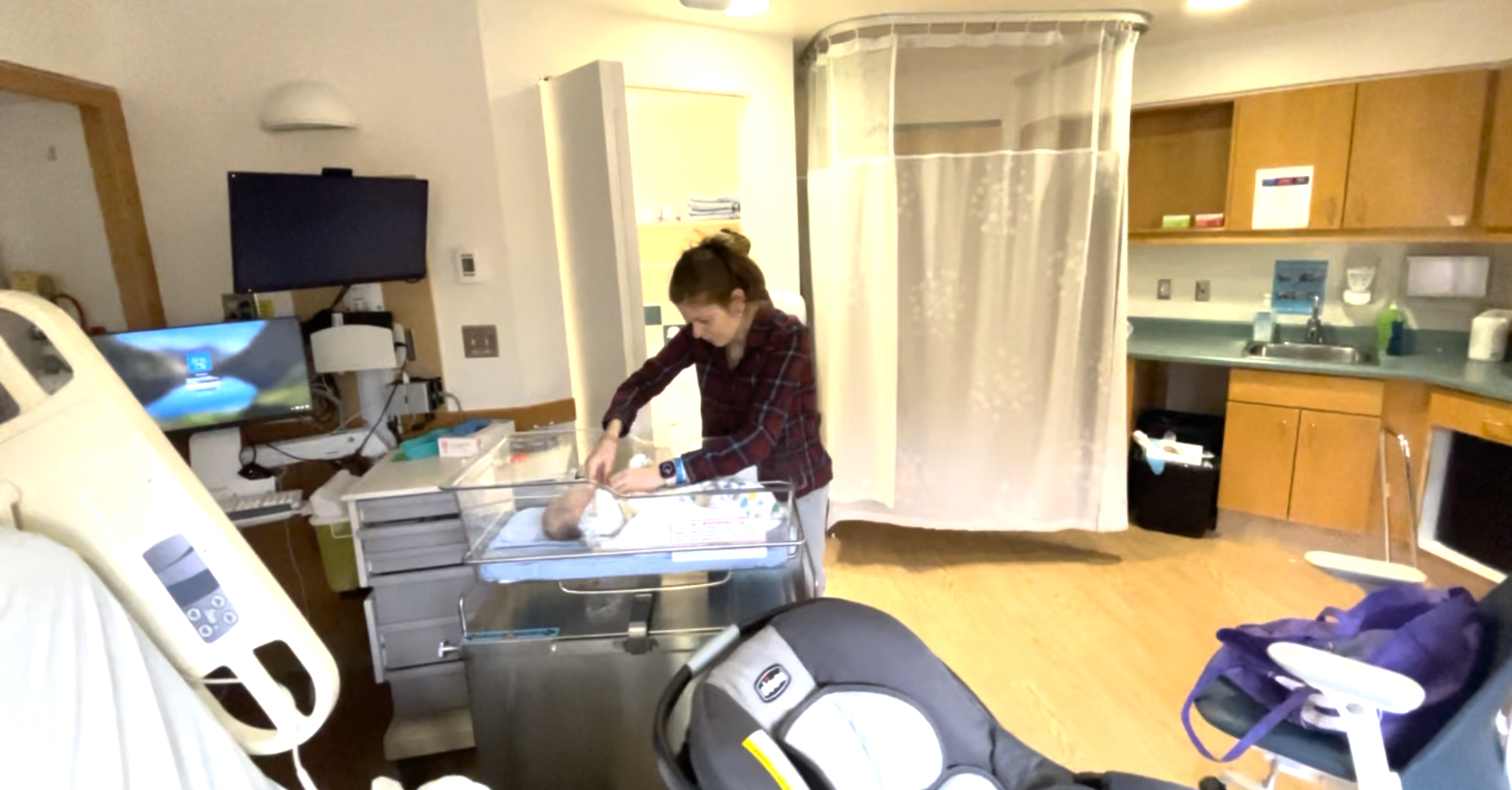
room
During labour, the lights are kept very dim — this is important for oxytocin, which drives contractions. It’s also much nicer for the baby: it was pretty dark in the womb, and soft lighting helps the newborn handle the stress of being born. The people attending the birth use a focused lamp that lights up just the area they need.
You can bring your own Bluetooth speaker and play your music, light candles, do whatever you want to make labour go according to your vision.
The coolest thing in our room was the call button on the bed. Press the red button and within a couple of minutes a nurse would appear and help with anything: teaching you how to change a diaper, helping with breastfeeding, answering literally any question or concern you had — and we had SO many. I genuinely couldn’t imagine how we were going to go home without that button. It was wonderful.
The birth itself
You can give birth standing, sitting, lying on your side, on your back, in the bath — however you want, as long as there are no medical contraindications. With an epidural, I think you can only push on your back, but they adjust the bed to make it comfortable.
Once the baby is born — assuming they cry — they’re immediately placed on your chest for skin-to-skin contact, and wiped down with a cloth right there on your chest. They stay there for about 10–15 minutes, then are taken for measurements. Unfortunately (or fortunately, I guess), our little one was born unexpectedly quickly (well, after 3 days of labour lol), and the nurses didn’t have time to remove my hospital gown — so he was placed on it rather than on my bare skin (at least that’s the excuse they gave the midwife when she asked about it). But after all the checks, they brought him back and did it properly.
Our boy was also met by a pediatrician to make sure everything was okay, because meconium had been found in the amniotic fluid. But when there are no medical concerns, measurements are done by the midwife or nurses.
You can cut the cord yourself, or they can do it for you. It’s standard to wait 1–2 minutes before cutting so the baby receives the remaining blood from the placenta. Some people want to wait 20 minutes — medically this isn’t great and can actually cause problems, but if the parents insist, their wishes will be respected.
During pushing, a mirror can be placed in front of you so you can watch what’s happening. We learned about this in our birth prep classes and the idea seemed absolutely insane to me — but actually a lot of people use it to track their own progress. I’ll say more about that in the “my story” section.
How the staff communicates
Before every single procedure — even medically necessary ones — they ask permission. Need to check dilation? They’ll say “would you mind if I touch you there right now?” and then announce it again before actually doing it. Everyone communicates with total respect, both toward the woman and the partner. There is absolutely no attitude that the man is somehow in the way. Partners are fully recognized as equal participants sharing all responsibilities. It’s really lovely.
Nurses also teach you everything you need to know: how to put on a diaper, how to swaddle (they do warn you that swaddling isn’t recommended at home, but the nurses find it easier in the hospital), how to wash the baby, how to hold them, how to breastfeed, and more. Every single staff member was an absolute sweetheart. I wanted to hug everyone on the way out.
What the hospital provides
Literally everything you need. The hospital website said they provide the bare essentials and you should bring your own things — but we didn’t use a single item we’d packed, and the nurses told us to save it all for home. In unlimited supply they gave us: Huggies diapers, swaddle blankets, postpartum underwear, feminine hygiene supplies, a peri bottle, a sitz bath seat for the toilet, pain relief tablets, nipple cream, a breast pump (if needed) with all accessories. The only things we used from our own bag were toothpaste, shampoo, and toothbrushes. At discharge, everything that was left — including the breast pump parts and the sitz bath — we were told to take home (they actually encourage you to).
What do they feed you?
Oh, the food at the hospital was amazing. A lot of people told me it was “just okay” — but they were all Canadian, and I don’t think they have any reference point for what “just okay” hospital food actually looks like (cue: grey mashed potatoes and a smelly cafeteria patty from a Russian public hospital). When we were moved to our room, they immediately gave us a printed menu with a phone number to call to place orders.
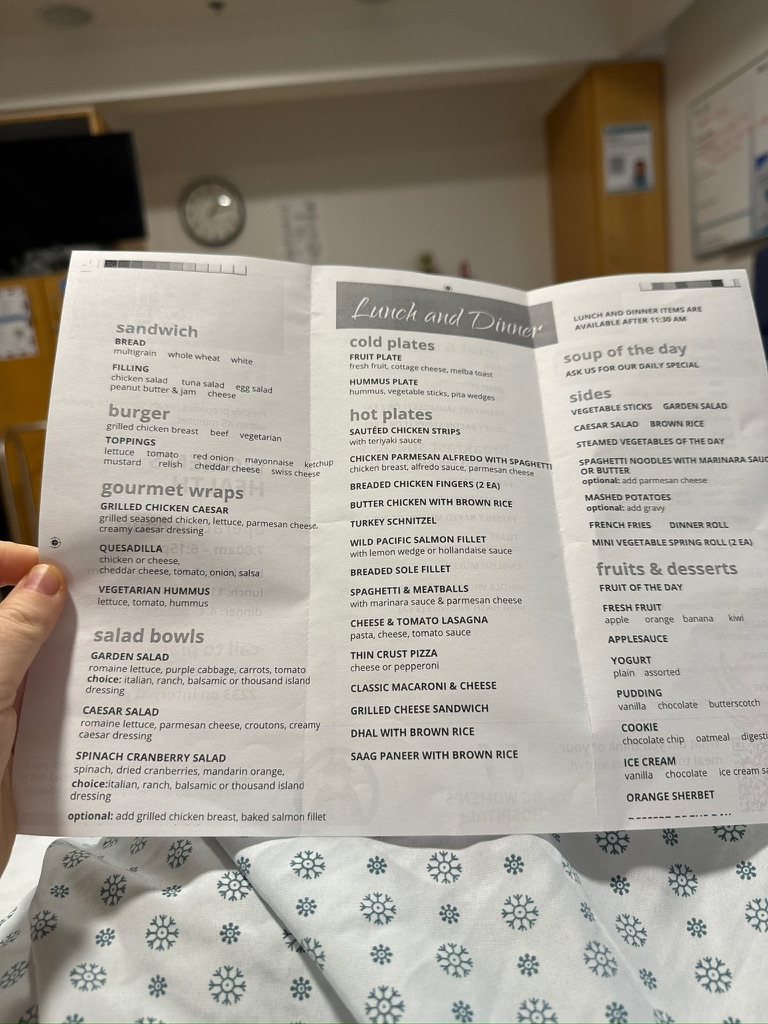
menu
There were no dietary restrictions after delivery, though the first time I called, they asked the nurse to confirm I didn’t need a special diet. Officially you could only order food for yourself, but everyone knows there are two people in the room and they just look the other way. You could order two items from each category, which meant we always had more than enough.
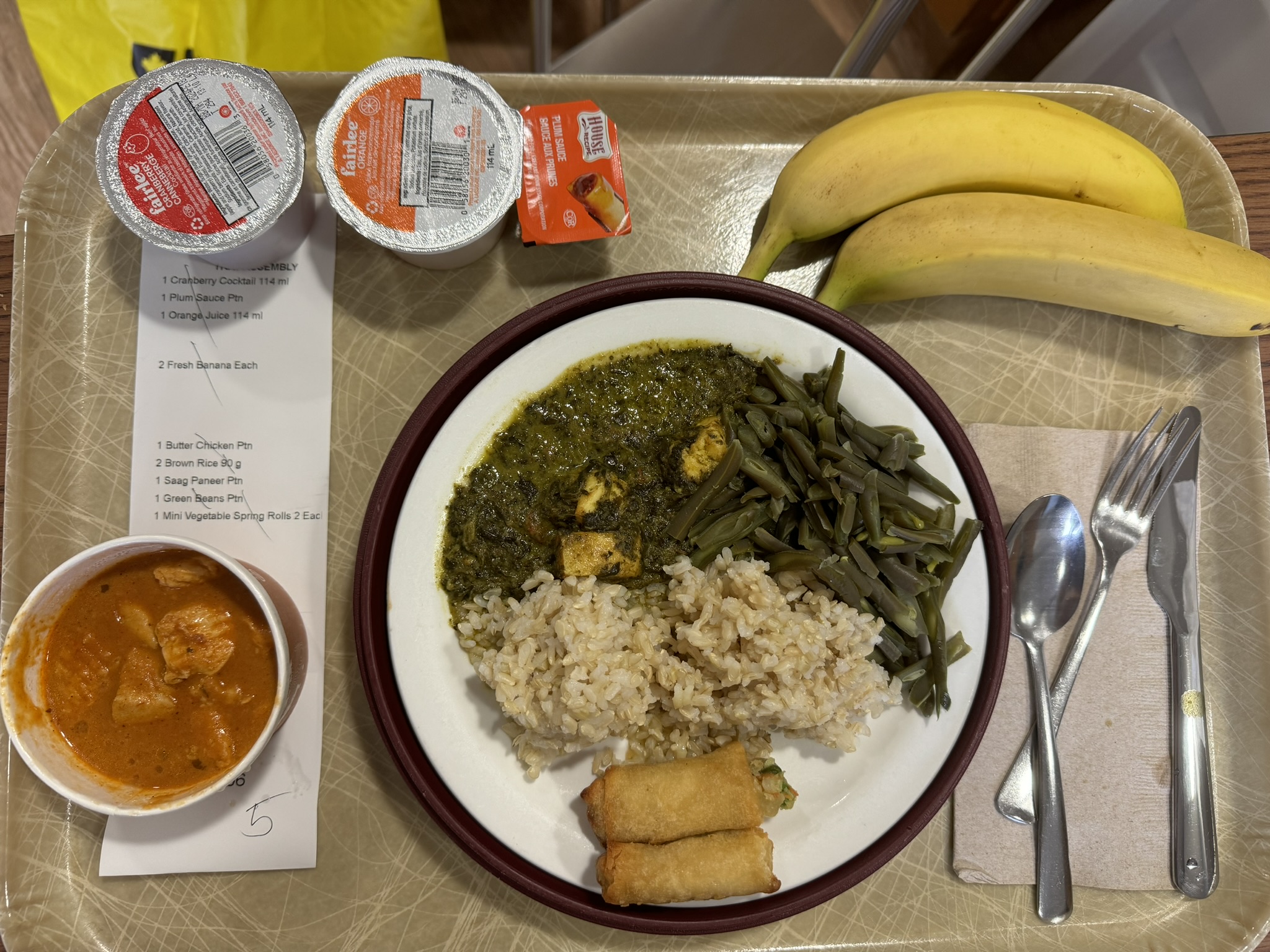
lunch
Besides the meal orders, there was a shared fridge in the hallway stocked with snacks: peanut butter, raspberry jam, apple juice, bread, cheese, crackers, cookies — and once, even guacamole. All available to grab at any time of day or night, with no limits.
When are you discharged?
If delivery went smoothly and the baby is fine, discharge is after 24 hours. My friend in Calgary delivered at 11 PM and was sent home at 2 AM — though she apparently wanted to leave. Because our boy had lost a bit more weight than expected, we stayed for two days, and I was genuinely grateful, because I did not want to leave. They fed us, helped us around the clock, and it was just wonderful. Before discharge, a nurse comes and explains what to expect, where to turn for help, hands over brochures with all of that information, and provides paperwork to register the baby. They also check that the car seat is properly installed — they won’t discharge you without it.
That’s roughly how it looks in theory. Now let me tell you how it actually went.
How did it actually go for me?
Oh boy. This is the expectation-vs-reality part. Feel free to skip this section if you have a weak stomach, haha. I’ll try to keep it brief and spare the gory details to protect your mental health.
When we were planning the birth, I somehow thought that if you were prepared enough, you could get through it without an epidural. My birth plan stated that I wanted everything natural, but if things went sideways, I was open to an epidural — that was about it. I didn’t even want the oxytocin shot for delivering the placenta, which as I understand is pretty standard practice. That idea was immediately shot down by my OB when she called at 38 weeks, because of some complications I had — she said the shot was necessary for me. Fine, I agreed, they know best.
A few days before contractions started, I had some bleeding that seemed heavier to me than the standard “bloody show” they warn you about at every third-trimester appointment (a normal sign that labour is near). I even called the midwife’s emergency pager one night because I was so worried, and we drove to the hospital a few times to check the baby’s heartbeat. Everything was fine each time and they sent us home.
Probably in some countries they would have admitted me at that point — but that’s not how it works here if everything else is normal. And by their assessment, the bleeding was minimal and within the normal range.
Monday
On Monday at 3 PM, contractions started. I was home, I’d been eagerly waiting for them, so I happily settled onto my exercise ball, turned on a movie, and started actively waiting 😄
After a few hours I developed what can only be described as an otherworldly pain in my back. We did everything we’d learned in class: calming music, candles, all the oxytocin vibes, D. giving me back massages, etc. Around 11 PM contractions were at 3-1-1, the pain was absolutely awful, and I was probably screaming loud enough to be heard across the whole building. We excitedly called the midwife, thinking we could finally go to the hospital. The on-call student (working alongside the midwife) answered and said that based on how I sounded, it didn’t seem quite time yet — because between contractions I sounded coherent. The pain being that intense at that interval? It happens, she said, laughing it off. Of course she added that if we felt like it was time, we could come in and they’d check dilation. And if the pain was unmanageable, I could come in for a shot of morphine.
At the time, that option sounded completely insane to me. I didn’t even want to take Tylenol, let alone morphine.
Tuesday
At 4 AM I called the midwife again and said I was ready to go in. They examined me and said dilation was veeery small, and that the reason for such intense pain was back labour — when the pain is felt in the lower back, often because the baby is positioned face-up (sunny side up) and the back of their head is pressing against your spine. It doesn’t happen all that often — only to the luckiest women!
They recommended the morphine shot so we could sleep and conserve energy for the labour that might (or might not) be coming soon. The student had previously worked as a doula, so she was also able to assess whether D. was doing everything possible to ease my pain (pressing on specific points on my back), checked that I was breathing correctly and making the right sounds (yes, how you vocalize during contractions actually matters), and did a massage herself — but nothing was helping anyway. I agreed to the morphine because I was dying. They checked the baby’s heartbeat, gave me the shot, and sent us home to sleep.
We slept exactly 4 hours — roughly how long morphine lasts — and then it all started again, this time with slightly longer intervals of around 6–7 minutes between contractions but with the same agonizing pain. Around 5 PM the midwife called to check in and said if this kept up, I’d need another morphine shot to be able to sleep again — but she recommended coming in around 10 PM this time, not 6 AM like the day before. Because pushing yourself to the point of “I’m dying” helps no one, not mother or baby. So that’s what we did.
The only problem was that the hospital was about 15 minutes away, and with back labour it’s impossible to sit or lie down due to the pain. In the car I simply couldn’t sit. They suggested I hug the back seat and face out through the rear window. I still wonder how none of the cars behind us at red lights called the police — they could clearly see something was wrong with me and that I was screaming in pain in the back seat. I would have assumed I’d been kidnapped at minimum, haha.
We arrived, they checked me, and again the dilation had barely changed over 24 hours — so they couldn’t admit me, but they were happy to give me another morphine shot. Worth noting: at every hospital visit I was always met by the on-call midwife. The hospital basically just provides the examination room; the shot itself was given by nurses, not the midwife.
Before sending us home, they laid out the plan going forward. If there was no progress, on Wednesday there would be the option of being admitted with an epidural and inducing labour artificially. If there was progress, they’d take it as it came. They sent us home — but this time, the shot unfortunately didn’t help, so we didn’t sleep at all and I just continued to barely survive at home. We also tried various exercises that might help the baby flip position and ease the pain, but nothing worked.
Wednesday
On Wednesday morning (the start of day three of contractions), I called the midwife and asked her to come to our home to check me. I was still hoping for a little progress and couldn’t face another pointless trip to the hospital — riding in the car was unbearable, even in the half-seated position they’d suggested. The midwife was a little uncertain whether there had been any progress, but agreed to my plan just to put my mind at ease. She came to our home and it turned out there was a small amount of progress. So I said I was willing to wait a bit longer and hold out for 4 cm — to this day I don’t know how I kept saying “just a little longer.”
At 8 AM the shift changed, and the on-call midwife who took over had a license in acupuncture. They offered to have her come to our home to do an acupuncture session, since there was a chance it could speed things up and might also help with the pain (it didn’t). She came with the doula student again, so I got another massage, which was lovely even if ultimately useless, haha. They stayed for about three hours, and finally my dilation reached 4 cm. We all headed to the hospital — in our own cars.
It was Wednesday, noon, and obviously the parking lot was packed. D. dropped me off at the entrance so I could get inside faster and went to look for parking. I have no idea what the staff expects of women who are supposed to arrive at the hospital in this kind of state, but I walked in screaming in pain and still had to somehow explain why I was there. I basically just yelled that I needed to be admitted urgently. They asked “for what? What’s happening?” and about a second later: “are you having contractions?” I nodded, and they finally started the intake process. D. showed up right as I was completely out of it and couldn’t answer a single question.
After they processed the paperwork (every hospital visit meant re-registering, by the way), they sent us to an examination room again to confirm I could actually be admitted. And that’s when I remembered what the student had said on Monday — that it probably wasn’t time yet because I sounded coherent between contractions. Because by this point I couldn’t speak, and I’m not sure I could breathe either.
First they checked the baby’s heartbeat, which was unfortunately elevated. This was because the pain had made me severely nauseous — I couldn’t eat or drink anything and was dehydrated. They immediately put in an IV and started fluids. They couldn’t start the epidural right away because of my low platelet count. I’d been warned during pregnancy that when I was admitted they would take blood, and only if the results allowed it would I get an epidural. This turned into a very long process — they needed the blood results and sign-off from a hematologist and an anesthesiologist. I think the whole hospital could hear me, because nurses kept running in to tell me they were all with me and were doing everything they could to rush the lab.
One nurse who was putting in the IV catheter asked where I was originally from. I mumbled “Belarus” and she said “mmm, Lukashenko.” The last thing I wanted to think about in that moment was politics — and specifically Lukashenko. Truly could not have predicted that I would be reminded of him while giving birth in Canada, haha.
Meanwhile, I was getting worse by the minute. They offered me laughing gas, which I was supposed to inhale before each contraction to dull the pain. I was willing to try literally anything at this point, because I was convinced I was dying. Laughing gas is just a joke, I told them — it barely helped, or maybe I was using it wrong. Plus it has nausea as a side effect, so naturally I was throwing up constantly. The choice was: nausea or pain.
Two hours later the epidural was finally approved, and they wheeled in a chair for me to sit in for the ride up a couple of floors. I just remember screaming that I absolutely refused to sit down because sitting was impossible, but there wasn’t much choice. And finally — we were in the room.
The nurse (there’s always a nurse in the room throughout labour and right after delivery) greeted me and asked if it was okay for a student nurse to be present too. I was nodding at everything at this point, because it was the last thing I cared about. Every 20 minutes they checked the baby’s heartbeat with a doppler and my pulse.
Finally the anesthesiologist arrived — a British man who started explaining the epidural procedure and potential side effects, while I just screamed that I agreed to all of it, please just help me. The midwife added that I had back labour and had been in bad shape for three days, so could we please hurry. D. signed the consent form for me since I was in no condition to do it myself, and I was just hoping that I would somehow come back to life — though I barely believed it was possible.
And again I understood why in some countries they won’t give an epidural in the late stages: you can’t move during the injection, and when contractions are every one to two minutes, that’s nearly impossible. During the procedure your partner sits in front of you so you can lean against them; nurses help hold you from the sides. The injection felt even more painful than the contractions themselves — but I was so relieved to finally be getting it. That was around 4 PM.
The anesthesiologist was absolutely amazing. He gave me a small dose — but enough that I could finally exhale and come back to myself. I could walk around the room, I had full sensation in my lower body, just no pain. Within an hour or two I felt human again and was even able to eat for the first time in days. They told me not all hospitals administer such a low dose — it also depends a lot on the skill of the doctor.
Of course, the IV had a button I could press to increase the dose myself, but I only used it once.
After the epidural, they’re required to hook you up to continuous fetal monitoring and a contraction monitor. After that, all I had to do was lie back, rest, and wait.
A couple of hours later they checked my progress — not much was happening, because an epidural often slows contractions. They also had to manually break my waters (which is standard procedure, as far as I know), and meconium was found in the fluid. After that, the OB came in and said she recommended starting a Pitocin (synthetic oxytocin) drip to increase contraction frequency, since it’s not great for the baby to stay in there without fluid for too long — especially with meconium present. I trusted them completely, so I agreed to everything. The midwife, for her part, was only checking in occasionally by this point; the nurses were with us the rest of the time. About once an hour they’d test whether the epidural was still working by running ice along my legs.
Around 11 PM, the baby’s heart rate started to spike significantly — which is common with synthetic oxytocin, so the dose kept getting adjusted up and down. But overall nothing dramatic was happening; I was just lying there, dozing, eating, sitting on the ball. Around 1 AM, the heart rate had been elevated for nearly an hour. The nurse was constantly calling the midwife, who couldn’t come because another baby had decided to arrive at the exact same time! Meanwhile, I was being warned about the possibility of a C-section — if nothing progressed, the elevated fetal heart rate was becoming dangerous territory. I was devastated, because I’d gone through all of this for three days, and a C-section could have been scheduled at any point (not really, because they don’t do elective C-sections here, but still).
Thursday
Nurses get periodic breaks during their shifts — a couple of hours to rest and eat. The nurse who came to cover ours was an older woman with over 40 years of experience. She started by telling us stories about how she’d known our on-call midwife since childhood, and how many births she herself had attended — too many to count, really, because she stopped counting after a thousand.
And then things got wild. Because the heart rate had been elevated for so long, something had to be done. The nurse decided to check my dilation — even though up until then, dilation checks had only been done by the midwife. But since the midwife was completely occupied with other deliveries, the nurse said she could do it herself, if we didn’t mind.
She examined me and it turned out I was basically ready to push — dilation was “zero minus three”! She called the midwife, who asked her to wait just a moment, she was almost done with the other delivery. I was in complete shock at the idea of waiting at this point, haha. The nurse got everything set up, and right on cue the midwife and student ran into the room. They literally sprinted down the hallway toward me — like a scene from ER.
They were great at coaching — telling me exactly what to do and which muscles to use. D. stood beside me and helped me track contractions by counting out loud, and I kept looking at the monitor to coordinate with what I was feeling, since the epidural had significantly reduced my sensation. Before labour, I’d seen birth prep videos where they put a mirror in front of the woman, and I remembered thinking “ugh, I absolutely do not want that” — my birth plan said no mirror. During the delivery they asked me again about the mirror and I said no — but D. said “come on, put it up, it’s interesting!” I agreed, and I have to say, it helped me enormously understand what was happening with my body and coordinate my pushing so much better. I now strongly recommend it — even though the idea still seems a little unhinged to me.
Just 20 minutes later, a human being was born and immediately placed on my chest. As I mentioned, the skin-to-skin didn’t quite go as planned — the nurses hadn’t managed to remove my hospital gown in time. But after all the checks, he was brought back and placed properly.
Our boy was also checked by the pediatrician because of the meconium in the waters. She gave him the all-clear.
The midwife had barely finished our delivery before her phone rang — someone else in another room had decided to give birth! She’d essentially just caught our baby and immediately ran to the next one. Three babies from the same midwife team decided to be born within 90 minutes — me at my due date, someone a week early, and someone a week late. Only the luckiest of timing.
Oh, and the placenta — you can actually take it home and do whatever you want with it. We declined that particular joy, haha.
The whole process lasted from 3 PM Monday to 2 AM Thursday.
A couple of hours later, once the epidural had worn off and the stitches were done, a nurse offered to help me walk to the bathroom. I stood up from the bed, they asked if I was okay, I said everything felt great — and a few seconds later I was having a lovely dream that was interrupted by someone calling “Natasha!” I opened my eyes to find myself surrounded by a crowd of nurses and D. Turns out I had fainted and stopped breathing, which meant they’d hit the emergency button and the whole staff had come running. The next day, everyone who came into the room asked “are you the one who fainted?” To this day I remember the exact moment I thought: mmm, finally, a nap 😄
As I mentioned, the baby had lost slightly more weight than expected, so we were allowed to stay an extra day. Doctors were constantly coming by to check on both of us. What I remember: they took blood from the baby’s heel every two hours because he was born around 3950 g and they wanted to make sure there were no blood sugar issues; they checked his hearing; they listened to him constantly. For me: they checked the epidural injection site, leg sensation, and blood, and even the head anesthesiologist came to see how things went. Because of the significant weight loss and because my milk hadn’t come in yet, the baby was offered donor milk (we had the choice between formula or donor milk, and we chose donor milk). We could take the remaining supply home with us.
Wrap-up
Looking back, first of all — I genuinely don’t understand how I made it through all of that. Second, even though it was exhausting to keep driving back and forth to the hospital, I was glad nobody pressured me into a C-section or induced labour when it could still be avoided. Third, I’m so glad I hadn’t mentally attached myself to my birth plan, because it went exactly zero percent according to plan. Didn’t want an epidural — ended up with morphine, laughing gas, an epidural, a mirror, Pitocin, and I managed to faint. And through all of it, I genuinely can’t imagine having made it without D. Not just because he was there, but because he was actively helping every step of the way. I’ve always been in favour of having a partner present at birth — but when people talk about this (at least in post-Soviet culture), they usually mean the final stage, when the baby is actually being born. In my case that turned out to be the easiest and shortest part. Nobody talks about the contractions themselves. I can’t imagine getting through that without someone physically and emotionally present the whole way through.
The birth prep courses we took online were incredibly helpful — especially the ones that shared real birth stories (like this one).
I also want to say: prenatal care and birth are the parts of the Canadian healthcare system that work — even with their Canadian quirks. For example, you can get an appointment with a specialist (in our case, a lactation consultant) within a week! But postpartum care, while excellent for the baby and the mother in those first few days and weeks, gradually reverts back to the normal realities of the Canadian healthcare system. And after 6 weeks postpartum, midwife care ends and you’re handed back to your family doctor — the one you can’t call at 2 AM, whose next available appointment is weeks out. But I’m not thinking about that yet.
Overall, I’m so glad the pregnancy and birth happened here, and with our midwives specifically. And now — back to survival mode 🙂